Viber for business in Bulgaria. Selling in a messenger with 90% reach
Bulgaria belongs to the short list of countries where Viber holds first place outright rather than splitting the market with rivals. At the same time only 57.0% of the population buys anything online, the second-lowest figure in the European Union. That combination is rare and it favours sellers. A communication channel with near-universal reach sits on top of a market that is nowhere near saturated, and the country’s switch to the euro on 1 January removed the currency barrier for sellers based abroad.
Key takeaways:
- Viber remains the number one messenger in Bulgaria alongside Belarus, Greece and Serbia, with reach around 90%
- 57.0% of the population shops online against an EU average above 73%, so the market has plenty of room left
- 63.46% of all web traffic in the country comes from smartphones, which makes chat on a phone the primary buying interface
- Cash on delivery remains widespread, and every unconfirmed order costs the seller a double shipment
- One Bulgarian Viber number connects to your CRM and can be worked by any number of people
- Viber offers no advantage to companies with long approval cycles and corporate procurement
The Bulgarian market in figures
We compiled this table from three independent sources — Infobip’s report on messenger popularity by country, the Bulgarian e-commerce overview published by Ecommerce Germany News, and Eurostat data on the share of online shoppers.
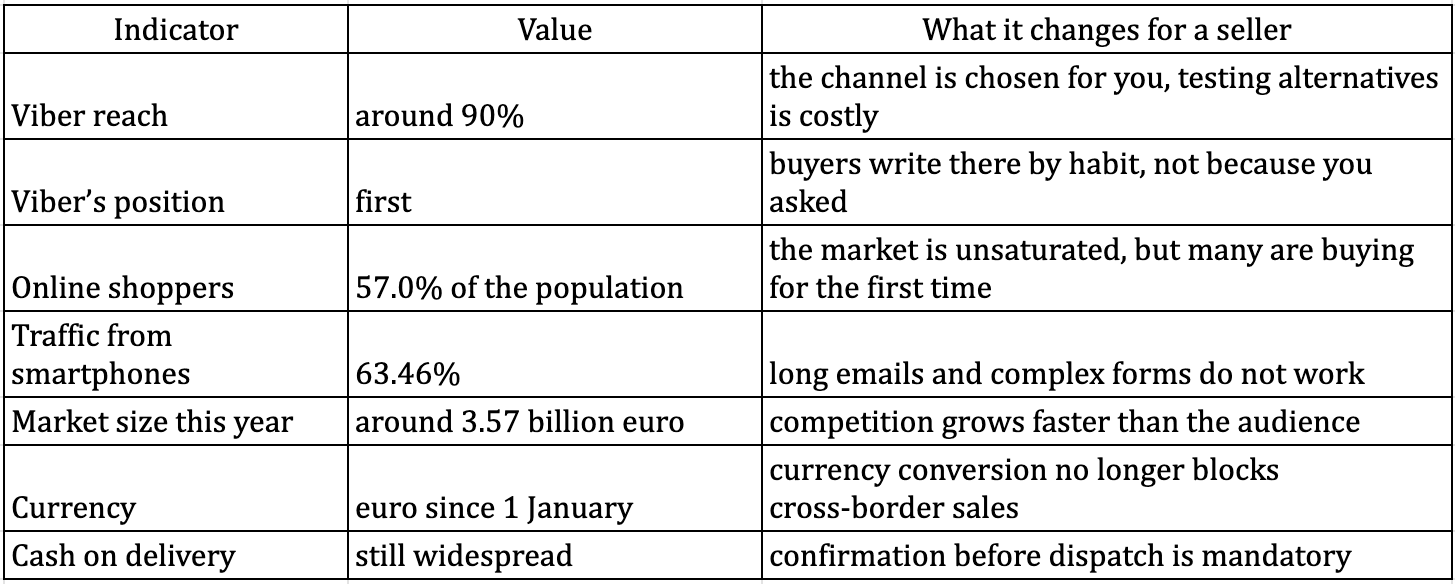
Sources — infobip.com/blog/most-popular-messaging-apps-by-country and ecommercegermany.com/blog/european-ecommerce-overview-bulgaria.
57.0% means a buyer who needs things explained
Half the Bulgarian audience already shops online with confidence, and a further slice did it for the first time within the past year. That second group needs answers rather than discounts. How long delivery takes, what happens if the size is wrong, whether anyone calls before the courier arrives.
They ask these questions in chat, because a first-time buyer will not fill in a contact form. A company without a live channel in Bulgaria loses precisely that part of the market, and that part is where the growth is.
The smartphone as primary screen dictates how you write
With mobile traffic at 63.46%, the buyer is reading your reply standing on a bus. The consequences for format are direct. Paragraphs no longer than two lines, the price in its own message, a photo instead of a description, and no attachments weighing tens of megabytes.
The same fact explains why calling works worse than writing here. A message can be answered at any moment, a phone call cannot.
The euro changeover shifted what buyers ask about
A single currency simplified cross-border trade, but it brought a wave of questions about converted prices, old price tags and refunds on orders placed while the country still used lev.
Questions like that almost never arrive through a website form. They arrive in the messenger, briefly and often irritably. Companies whose enquiries land in a shared CRM stream answer them quickly and consistently. Companies where conversations live on salespeople’s phones give five different answers to one question.
The cost of silence with cash on delivery
One working term. The cost of silence is what a seller loses on every order shipped without a confirmation message. It is made up of outbound delivery, the return leg, packaging, and an hour of somebody’s time processing the return.
A calculation over 100 orders shows the scale
Take a notional shop with an average order of 60 euro, delivery at 4 euro each way, and 100 cash-on-delivery orders a week.
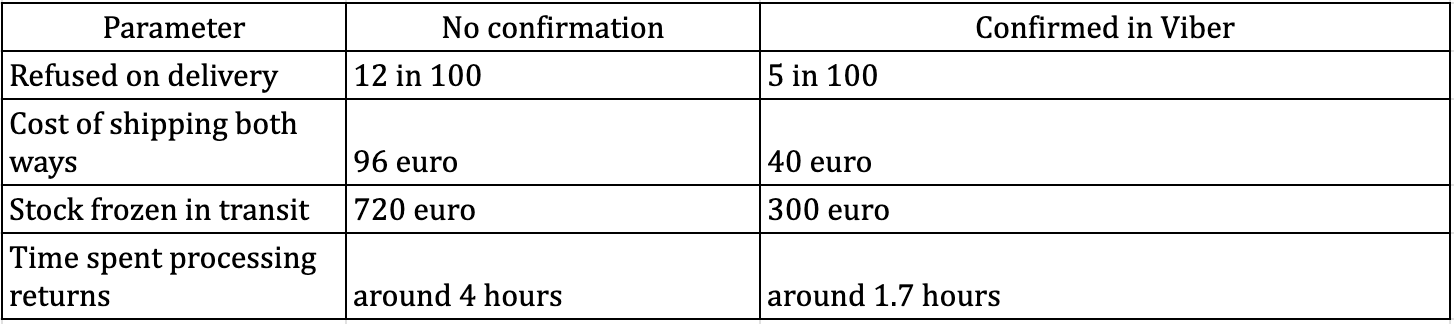
The refusal rates are a starting point for the calculation rather than a measured figure, so substitute your own. The point of the exercise is elsewhere — avoiding a single refusal covers a month of running the number, and that is the only arithmetic the decision requires.
Confirmation takes two messages and nearly always gets a reply
The first message names the order and asks the customer to confirm the address in one word. The second goes out on dispatch day with the tracking number.
A phone call performs worse at the same job for two reasons. Half the time nobody picks up, and among those who do, some agree verbally and still refuse the parcel, because a spoken yes commits to nothing. A written confirmation functions as a commitment and stays in the customer card.
Selling on Viber in two kinds of business
An online shop closes the cycle in five touches
Order confirmation immediately after checkout. A check before dispatch for cash-on-delivery orders. The tracking number when the parcel goes to the courier. A message on delivery day. A satisfaction question three days later.
Everything else fits between those points — a photo of the product in another colour, the warranty document, an unboxing video. The messenger carries files, images, video, voice notes and video messages, so nobody has to switch to email at any stage.
A separate word on repeat sales. More than 40% of Bulgarian online businesses do not sell outside the country, meaning they compete with each other on one limited market. A six-month-old conversation sitting in the customer card gives a seller a reason for a second approach that competitors do not have.
A service company replaces telephony with three messages
Installation, repairs, maintenance, healthcare and beauty all run on scheduling. The working pattern is confirmation on booking, a reminder 24 hours ahead offering to reschedule, and a short reminder on the day.
The technician heading to an address writes to the customer from the job card rather than from a personal number. The difference shows up the day that technician leaves — the job history stays with the company.
The first message is written in Bulgarian regardless of where the seller sits
Being able to write first solves the common case where an enquiry contains a phone number and nothing else. A short message in three parts does the job. Who is writing, what about, and what you need from the customer.
Something like “Здравейте, това е Мария от магазин Х по вашата заявка за кафемашина. Моля, уточнете удобен адрес за доставка.” English in chat sharply reduces reply rates among the over-40s, and this is a case where having a native speaker translate your templates pays for itself within a week.
Expert note
Companies entering the Bulgarian market from abroad routinely import their home channel logic. A German company opens WhatsApp, a Polish one brings Messenger, a Ukrainian one sets up Viber and turns out to be right by accident. The test takes a week and costs nothing. Take your last 100 enquiries, send half a message on Viber and half through whatever you normally use, then compare reply rates over 24 hours. On a Bulgarian sample the gap in Viber’s favour is usually a multiple, and after that the internal argument about channels ends by itself.
Viber on a personal phone and Viber in a CRM differ in control
A salesperson’s personal account breaks on four events
The salesperson falls ill and nobody answers their customers. The salesperson leaves and takes the conversations. A customer claims they were quoted a different price and there is no way to check. The manager wants to understand why conversion dropped and runs into an absence of data.
Individually each of these looks like bad luck. Together they add up to a loss nobody is counting.
The customer card changes the quality of the answer, not the speed
With the integration in place your salesperson works in the CRM they already know. Messages arrive in the customer card, where the orders, amounts, call history and tasks already are.
They can see the person bought in March, that there was a complaint about timing, and that they were choosing between two models. The answer comes out specific without a single clarifying question. Messages can be sent from the CRM or from the app itself — either way the history is written into the card.
No plan limits how many people work on one number
The company shows customers one number while several people answer it on rotation. For retail with any volume of enquiries, that is the only way to keep response times sane.
Growing the sales team requires no extra payment, no new number and no reconfiguration.
The limit of running two departments on one number
The arrangement breaks when sales and support share a contact. A customer with a complaint reaches a salesperson, who forwards it internally, and response time grows. Above roughly 100 enquiries a day it is worth splitting departments across numbers, particularly since discounts apply from three numbers up.
Platform rules on new contacts
Viber restricts messages to people who have not written to you
This protects users from bulk campaigns rather than being a technical quibble, and it should be treated as a fact of life.
Three rules follow. Do not send identical text to a large group of new numbers. Do not open with a promotion. Keep the first wave small and watch the reaction before scaling.
Contacts who wrote to you first are not covered by the restriction. That makes a Viber button on your website and on your receipts the cheapest legitimate way to grow a base you can message.
A sending window of 9am to 8pm reduces complaints
Bulgarian business correspondence is more courteous than the regional average without being more formal. Polite forms of address, short sentences, no exclamation marks.
Messages after 9pm arriving in an app that sits next to family chats read as an intrusion and generate complaints more often than sales.
When Viber gives no advantage in Bulgaria
Corporate procurement stays in email
The argument of this article is simple — Bulgarian buyers reply in messengers. The counter-argument is that a procurement officer at a large company is not permitted to approve a supply agreement in a chat, because they need a document with company details and a signature.
The limit follows from that. In business-to-business deals Viber works as a channel for clarifications and reminders, not for approval. In practice, keep the messenger for speed and send legally significant documents by email, recording the fact of sending in the customer card.
Cold outreach does not pay for itself
Mass messaging to unknown numbers hits the platform’s restrictions faster than it produces enquiries. For cold traffic in Bulgaria the cheaper route is advertising with a click-to-chat button, so the buyer opens the conversation.
What we have not measured
Everything above applies to retail and services with short sales cycles. For medical services and financial products, where additional personal data requirements apply, we have no Bulgaria-specific statistics.
We should also restate that the refusal rates in the cost-of-silence calculation are a model for plugging in your own numbers rather than a measured market figure.
Launching the channel in a week
The technical part takes under a day
Connecting a number is four steps — register with E-chat, activate the Viber number with confirmation from the phone, let it sync on the same principle as the desktop client, and connect it to the CRM following the instructions.
The rest of the time goes on content. Translating templates into Bulgarian, setting up inbound routing, configuring two or three automated messages and agreeing response-time rules. The first 7 days are free, which is enough to run real orders through the channel.
Three metrics for the first month
Time to first response. For Bulgaria, aim for under 15 minutes in working hours, because the buyer is comparing you with their personal conversations.
Share of enquiries that turn into a conversation. If 70 out of 100 enquiries become a dialogue, the channel works. If 30 do, the problem is either the wording of your first message or how fast it goes out.
Refusal rate on cash-on-delivery orders before and after introducing confirmation. The effect shows within the first month and converts directly into money.
FAQ:
Question: Do we need a Bulgarian number or will one from another country do
Answer: Technically any number works, but a local one noticeably lifts reply rates. After a wave of phone fraud Bulgarian buyers treat foreign numbers cautiously, and this affects first contact far more than the conversation that follows
Question: How does connecting a number to a CRM differ from Viber’s advertising products
Answer: They serve different purposes. Advertising works on reach and brand awareness, a connected number works on personal conversation and the sale. Neither replaces the other and they run happily in parallel
Question: What happens to conversations when an employee leaves
Answer: The whole history stays in the customer cards, because the number belongs to the company. A new colleague opens the card and continues the conversation from where it stopped
Question: What does a Viber number cost
Answer: The plan is 29.99 dollars per number per month, with discounts of up to 40% when connecting three or more numbers and paying for 3, 6 or 12 months. Inbound and outbound messages are unlimited
Question: Can we run Viber and Telegram at the same time
Answer: Yes, numbers on different messengers connect to one CRM and write into shared customer cards. For companies working across the Balkans and Central Europe this is the usual configuration
Was this article helpful?
Share it with colleagues who might need it
Connect messengers to your CRM
Message clients first right from the client card and keep all conversations in your CRM. 7-day free trial, up to 40% off when connecting several numbers.