Telegram for sales in Uzbekistan. Running a sales team inside the country’s main messenger
In Uzbekistan Telegram long ago stopped being a messenger and became the environment where everything happens at once — news, classifieds, shops, support, negotiations. Meanwhile the number of e-commerce marketplaces in the country grew from 36 to 115 in a single year. Buyers now have plenty of people to write to, and what decides the sale is no longer the catalogue but who replies first. Below is response speed treated as a conversion factor, the market in figures, and the boundaries past which this channel stops working.
Key takeaways:
- Telegram reaches 70–76% of the audience in a country of over 38 million people with internet penetration around 89%
- The number of e-commerce marketplaces rose from 36 to 115 in a year, with online trade turnover reaching 22.7 trillion soum
- Buyers write to several sellers at once, so time to first response affects the deal more than price does
- First contact goes out in Uzbek, after which the conversation follows whichever language the customer replies in
- Personal accounts stop working once the team reaches three people
- Bulk outreach to a cold list fails even though the platform’s rules are relatively relaxed
The Uzbek market in figures
We compiled this table from data published by the National Agency of Perspective Projects for last year, Infobip’s report on messenger popularity by country, and open statistics on internet penetration.
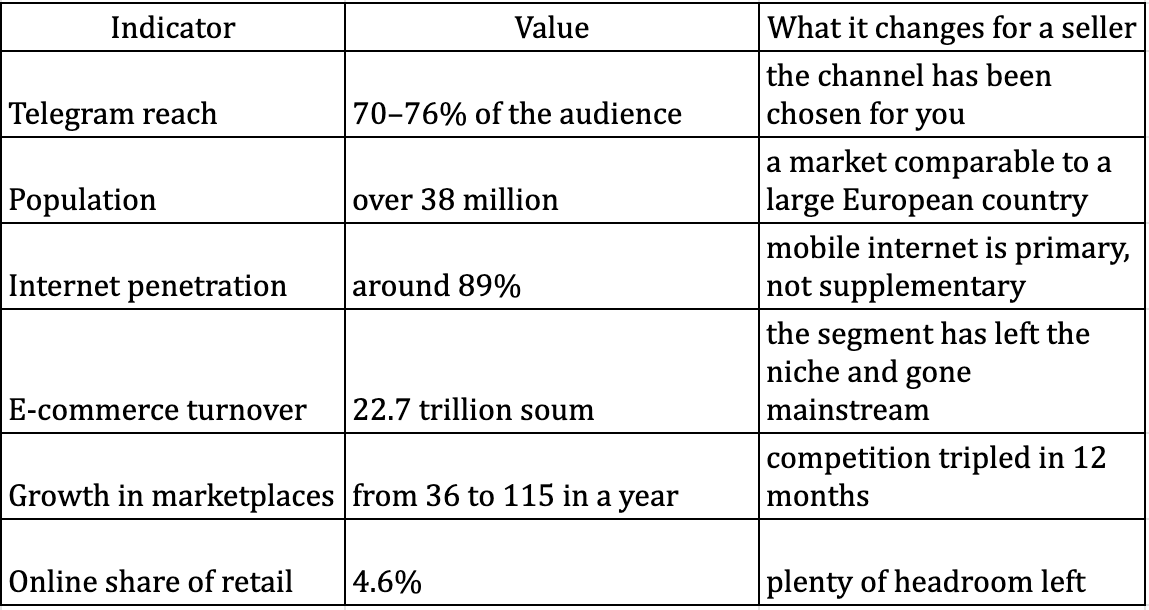
Sources — fintech-retail.com citing the agency, and infobip.com/blog/most-popular-messaging-apps-by-country.
A 3.2-fold increase in marketplaces moved the competition to speed
One working term. The parallel seller queue is the number of companies a buyer has written to about the same thing before receiving a first reply. A year ago that queue held one or two companies, now it holds three or four.
Inside that queue it is not the best offer that wins but the first coherent one. While you are drafting a thorough answer, the buyer is already talking to whoever replied in five minutes.
Mobile-first access dictates the shape of your message
With penetration around 89% and access overwhelmingly mobile, the buyer reads your reply on the move. They will not open a long proposal.
What works is short text, a 30-second voice note and a photograph. A document belongs there only when the customer asked for one.
Telegram functions here as a directory service
People are used to getting answers in a messenger rather than finding them on a website. A company with no Telegram presence looks unreachable, however good its site is.
The consequence for anyone entering the market is straightforward. Putting the website first and the messenger second is the wrong order here. Reverse it.
Building the sales process
The first message goes out within 10 minutes and contains one question
The platform treats messages to new contacts noticeably more liberally than most of its competitors. That is an advantage you can destroy quickly by blasting identical text at a list.
The sensible logic runs like this. An enquiry from the site, from a channel or through a referral — you write first, within 10 minutes. A cold list with no reason for contact — you do not write at all.
The message has three parts. Who you are, where you got their contact, and one specific question. The question is essential, because a statement can be left unanswered while a question gets answered almost reflexively.
First contact in Uzbek, then follow the customer’s language
Tashkent and the business environment are largely bilingual, the regions lean considerably more towards Uzbek, and younger audiences prefer Uzbek even when their Russian is fluent.
The working approach is to send the first message in Uzbek and then switch to whichever language the customer replies in. Keep automated notifications in two versions, selected by a field in the customer card.
A channel and a private conversation do different jobs
A common confusion among companies entering this market. A channel builds an audience and warms it with content. The deal is closed in a private conversation.
The connection works like this. The channel publishes content plus a button to message a salesperson. That move from channel into private chat is the enquiry, and it needs recording in the CRM with its source. Without that record you will never know whether the content pays for itself.
Aim for 10 minutes to first response
Three things get you there. Routing inbound messages across the team, templates for the common questions, and an out-of-hours auto-reply that captures the enquiry until morning.
All three are configured on the CRM side once the number is connected. The auto-reply is not a formality here — a buyer who writes at 10pm local time will have worked through the parallel seller queue by morning.
Why personal accounts stop working
The threshold arrives at three people
While one or two people handle sales, personal accounts look like a working solution. From three onwards you hit problems that cannot be organised away.
Two people write to the same customer because neither sees the other’s conversations. One falls ill and their customers go a week without a reply. The manager cannot work out why one salesperson converts twice as well, because there is nowhere to read the conversations.
A departure takes the negotiation history with it
A salesperson leaves and takes an account holding two years of conversations. Customers keep writing to them while they are already working for a competitor.
When the number belongs to the company and runs through a CRM, the history stays in the customer cards. The new hire opens the card, reads the thread and continues the deal. Onboarding instead of losing the base.
A single conversation history gives the manager evidence instead of anecdotes
You can see where a deal stalled, which phrasings lead to refusals, and who is replying two hours late.
There is separate value for repeat sales. A conversation from six months ago holds things the customer will not repeat — which size they took, what did not suit, when their busy season falls.
Expert note
Companies moving into Uzbekistan from neighbouring markets often import an entire funnel that was built elsewhere. In Kazakhstan WhatsApp effectively replaces telephony, and a process designed around it works at half strength here because the audience lives in a different app. Test this directly rather than analytically. Take your last 100 enquiries, split them in half and send the first message through different channels. On an Uzbek sample the gap in Telegram’s favour usually shows by the second day. The other thing worth building in from the start is keeping Telegram and WhatsApp under one CRM if you plan to expand across Central Asia. Rebuilding your communication architecture a year from now costs more than connecting two numbers today.
The technical side of launching
Connecting a number takes four steps
Register with E-chat, activate the Telegram number with confirmation from the phone, let it sync on the same principle desktop clients use, and connect it to the CRM following the instructions.
Ready-made integrations exist for Bitrix24, amoCRM, KommoCRM, NetHunt, Creatio, SalesDrive, KeepinCRM, Odoo, OneBox and a number of other systems. If your CRM is not on the list, ApiX-Drive, Wepster or the API will cover it.
The apps on your phone and desktop keep working after connection, and the number is not locked out of ordinary use.
No plan limits the number of people working on one number
The company shows customers a single contact while several people answer it on rotation.
The rule worth writing down immediately is that one conversation belongs to one salesperson until it closes. Otherwise the customer gets two different answers to one question, which irritates more than a long silence.
Three rules that keep a number alive
Do not send identical text to a large list of strangers. Do not open a conversation with a price list. Keep first-contact messages to a sensible share of your total outbound.
The service itself imposes no limit on message volume. The limits come from the platform, and while it is more permissive than its competitors, it is not unlimited.
A specific risk for companies running seasonal campaigns
The situation that breaks the channel at the worst possible moment. Sales runs quietly for six months, then marketing fires a seasonal campaign at the whole database, part of which has never written to you. The number picks up restrictions at the peak of the season. Separate transactional and outreach messages onto different numbers if database campaigns are part of your plan.
When Telegram is not the answer
Response speed does not help if nobody is on shift
The argument of this article is simple — whoever replies first wins. The counter-argument is that speed comes from people rather than from a channel, and no integration answers on a salesperson’s behalf at three in the morning.
The limit follows from that. Connecting a number only shortens response time when there is a shift and a set of rules behind it. In practice, first work out which hours your enquiries actually arrive in and cover those hours with people, then connect the channel.
Cold lists do not pay off even under relaxed rules
The freedom to message new contacts tempts companies into bulk campaigns. Practice shows the opposite — response to cold outreach is low while the risk to the number is real.
For cold traffic the cheaper route is advertising with a click-to-message button, so that the buyer starts the conversation.
What we have not measured
The 70–76% reach range comes from different sources and we cannot give an exact figure. For planning purposes, work from the lower bound.
One caveat on regional differences. Every observation about language and response speed applies to urban audiences. We have no data on buyer behaviour in rural districts, where internet penetration sits below the national average.
FAQ:
Question: Do we need an Uzbek phone number or will any number do
Answer: Technically any number works, but a local one raises response rates, particularly outside the capital. A foreign number puts people on guard at first contact, though once the conversation is running it makes no difference
Question: How does a connected number differ from a bot
Answer: A bot acts on behalf of a service and cannot message someone who has not subscribed to it. A connected number is an ordinary company account with everything private messaging offers, including initiating conversations and full attachment handling
Question: What happens to conversations if the number’s plan expires
Answer: Sending through the service pauses, while the history already in your CRM stays exactly where it is, because it is stored on your side. Everything resumes once the plan is renewed
Question: Can we run Telegram and WhatsApp from one CRM for different countries
Answer: Yes, numbers on different messengers connect to the same system and write into shared customer cards. For companies covering Uzbekistan and Kazakhstan at once this is the standard setup
Question: What does a Telegram number cost
Answer: The plan is 16.99 dollars per number per month with unlimited inbound and outbound messages. Connecting three or more numbers and paying for 3, 6 or 12 months brings a discount of up to 40%
Was this article helpful?
Share it with colleagues who might need it
Connect messengers to your CRM
Message clients first right from the client card and keep all conversations in your CRM. 7-day free trial, up to 40% off when connecting several numbers.