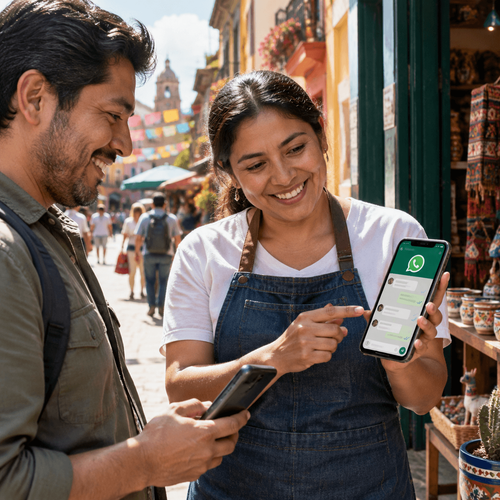
How a travel agency answers clients in 3 messengers from 1 window — a peak season case study
July. A traveller is choosing between Antalya and Hurghada, sends a question on WhatsApp, clarifies details on Telegram an hour later, and meanwhile his mother asks about the same package on Viber. The agent keeps 3 apps open plus a phone, a tablet and a spreadsheet of enquiries. Below is the actual setup a 5-person agency used to pull all 3 messengers into 1 window inside its CRM through E-chat, stop confusing conversations and cut first response time from 40 minutes to 4. Every step is described so you can repeat it in 1 working day.
July. A traveller is choosing between Antalya and Hurghada, sends a question on WhatsApp, clarifies details on Telegram an hour later, and meanwhile his mother asks about the same package on Viber. The agent keeps 3 apps open plus a phone, a tablet and a spreadsheet of enquiries. Below is the actual setup a 5-person agency used to pull all 3 messengers into 1 window inside its CRM through E-chat, stop confusing conversations and cut first response time from 40 minutes to 4. Every step is described so you can repeat it in 1 working day.
Key takeaways:
- In peak season travellers write wherever suits them, so an agency needs presence in at least 3 messengers: WhatsApp, Telegram and Viber
- Conversations on reps’ personal phones leave with the reps; conversations running through a CRM integration stay in the customer card permanently
- Connecting 3 numbers to a CRM through E-chat takes under 1 hour, and the routing rules are configured on the CRM side
- First response speed is the decisive factor in seasonal sales, because a traveller sends the same request to 4 or 5 agencies and buys from whoever answers first
- The ability to message first lets you chase balance payments, nudge undecided travellers and win back last year’s clients
- Paying for 3 or more numbers earns a discount, so being multichannel costs less than it looks
Why travellers message everywhere at once in summer
Booking peaks in June and July. People choose holidays in the evening after work, on a phone, lying on the sofa. Calling feels like effort and website forms take too long. A messenger is the ideal format: ask a question, get an answer, forward a hotel screenshot to your partner. The problem is that everyone’s messenger of choice is different. A family of 4 can easily talk to an agency across 3 different channels at once, and all those threads concern 1 booking.
Agencies that funnel everything into 1 “official” WhatsApp number cut their own conversion. A traveller will not install an app just to talk to you. They will message the competitor who is already on their channel.
What a day looks like without a single window
Anyone who has worked a peak season in a travel agency knows the picture. A work phone with WhatsApp on the desk, a personal phone with Telegram, Viber open on the computer. Website enquiries land in email. The agent replies to a traveller on WhatsApp while searching for the same person’s question from yesterday on Telegram, because they cannot remember whether the discussion was about Kemer or Side. The conversation history has to be reconstructed from memory. If the client went quiet for 2 weeks and came back, the thread has sunk 3 screens down.
Add shift changes. An agent goes on holiday and their clients keep messaging their number. A colleague physically cannot see those messages. The client waits, gets nervous and leaves.
What 1 unanswered message costs
Take average figures. A summer package for a family runs to $2,500–3,500. Agency commission is 7–10 %. Every lost conversation is $200–300 of income not earned. In peak season an agency with 5 agents receives 60–100 enquiries a day. If even 5 % of messages go unanswered for more than 2 hours, the monthly total covers a messenger integration for several years. And a traveller who did not get a reply rarely comes back — the market is crowded and alternatives are one tap away.
The case. One agency connected 3 numbers and stopped losing enquiries
Here is a typical implementation of the kind the E-chat team runs for travel agencies regularly. A mid-sized agency: 5 agents, 2 offices, a CRM already in place but with messaging living entirely outside it. The owner added up the enquiries lost in June the previous year and decided to fix it before the new season.
The starting point and the brief
Before the project, the agency had 4 SIM cards scattered across agents, plus personal numbers people used “because it is faster”. Deal history in the CRM was filled in manually and late. The owner could not verify what an agent had promised a client. The brief was simple: every inbound message from WhatsApp, Telegram and Viber must land in the CRM, attach to the customer card and be routed between agents by clear rules. Plus the ability to message travellers first, whether about a balance payment or a last-minute offer.
The connection scheme through E-chat
The agency set up 3 working numbers, 1 per messenger. In the E-chat dashboard, each number was activated and synchronised with its messenger. The mechanism is the same as signing in to a web version of a messenger on a computer, so there are no bots and no grey schemes — the conversation comes from an ordinary live number that travellers trust. The service was then connected to the agency’s CRM using the step-by-step guide. The whole process, including test messages, took around 50 minutes. A budget note: connecting 3 numbers at once earns a discount, which rises to 40 % on a 12-month payment.
How enquiries were routed between 5 agents
This is the interesting part that competing articles tend to skip. A single window does not by itself answer the question of who handles a given traveller. The agency configured 3 rules on the CRM side. First, if the traveller already exists in the database, the conversation goes to their assigned agent regardless of messenger. Second, new enquiries are distributed in rotation among available agents so the load stays even. Third, if the assigned agent has not opened the conversation within 10 minutes, the manager gets a notification and reassigns it. The whole conversation stays in the customer card, so the handover loses no context. The new agent reads the history in 2 minutes and continues, and the traveller never notices the switch.
Expert note. From an E-chat implementation specialist: “Travel agencies often ask for a separate number per agent. We talk them out of it. In practice, 1 number per messenger plus routing inside the CRM is more reliable. The client always writes to 1 contact they know, and the system decides who answers. When an agent resigns or goes on holiday, nothing changes for the traveller. One more tip from experience: set an out-of-hours auto-reply with an honest response time. ‘We will reply by 10 a.m. tomorrow’ holds a traveller far better than silence.”
Results after 1 month of the season
The agency pulled the figures from CRM reports, comparing July with the June before implementation. Average first response time fell from 40 minutes to 4. The share of enquiries left unanswered within a day dropped from 6 % to effectively 0. Conversion from enquiry to package selection rose by 18 %, because agents stopped losing time switching apps and hunting for old conversations. For the first time the owner saw the full picture — how many enquiries each messenger delivers and which agents close them fastest. It also turned out that Viber accounted for 22 % of enquiries, despite having been written off as a dead channel that nobody checked.
How to repeat this in 1 day
The good news is that nothing here requires a developer or a week of implementation. The plan below is written for an ordinary agency manager who is comfortable with a computer.
Step 1. Prepare numbers and decide which channels you need
Three SIM cards are enough to start. Use dedicated working numbers rather than agents’ personal phones — this matters. The number belongs to the company, so the conversation belongs to the company. Look at your enquiry statistics from last season. If your clients are over 45, Viber is essential. The 25–40 group lives on Telegram. WhatsApp is close to universal in most markets. Register at e-chat.tech; the first 7 days are free, so the whole scheme can be tested before any payment.
Step 2. Activate the numbers and connect your CRM
Activating each number takes a few minutes and is confirmed from a mobile phone, exactly as when signing in to a messenger on a new device. Once synchronised, connect E-chat to your CRM using the guide in the dashboard. The service works with more than 20 systems, and if yours is not on the ready-made list, connection is possible through Apix-Drive, Wepster or the open API. Be sure to send yourself test messages from all 3 channels and confirm that each creates a customer card.
Step 3. Configure routing and agree the rules
Set up the logic from the case above in your CRM: existing clients go to their own agent, new enquiries rotate, stalled conversations escalate to the manager. Write a short internal standard for the team. Maximum first response time in season: 5 minutes during working hours. Everything promised to a client is recorded in the deal. Messaging from personal numbers is not allowed. Introducing the standard takes 1 team meeting; getting used to it takes 1 week.
Step 4. Use outbound messaging properly
The ability to message first is what most agencies never use, even though it is what drives repeat sales. Build 3 scenarios. A balance payment reminder 3 days before the deadline. A message to an undecided traveller a day after the options were sent: “found an option $150 cheaper, want to see it?” And an early-season message to last year’s clients about their favourite destination. E-chat does not limit outbound volume; the limits belong to the messengers and apply to new contacts, so warm the list up gradually rather than in 1 evening.
What to watch so the setup runs smoothly
A single window removes 90 % of the friction, but the messengers have their own rules and it pays to know them in advance. Otherwise even a perfectly configured integration will trip over external limits.
Messenger limits on new contacts
Viber is the strictest about messages to people who are not in the number’s contact list; heavy outbound volume to new recipients can trigger restrictions. Telegram is more relaxed about first contact. WhatsApp watches recipient complaints, so outbound messages must be personal and relevant rather than looking like advertising. The practical conclusion is simple: handle inbound enquiries without restraint, and dose outbound campaigns to cold lists while watching the reaction.
Team discipline matters more than technology
The tool will not help if agents keep replying from personal phones out of habit. For the first 2 weeks the manager should review the response time report daily and gently steer the team back into the single window. After that the habit holds by itself, because working this way is genuinely faster. One more point: build reply templates for the 10–15 standard questions about documents, transfers and insurance. If your CRM supports automated messages, it will take that routine over entirely.
FAQ:
Question: Can we move our existing agency numbers into E-chat, the ones clients already write to?
Answer: Yes, any active number with a live messenger account can be connected. There is no need to tell travellers anything — they keep writing to the contact they know and the messages appear in your CRM.
Question: What happens to conversations if the agency changes a number?
Answer: The history is preserved. All conversations are attached to the customer card in the CRM rather than to a SIM, so replacing the number leaves past threads in place.
Question: Will the traveller notice that replies come from a CRM rather than a normal messenger?
Answer: No. To them it is an ordinary conversation with an ordinary number. Messages, files, hotel photos, voice notes and video arrive exactly as usual.
Question: How many agents can work with 1 connected number?
Answer: As many as you like — E-chat does not cap users on any plan. Whether it is 2 agents or 20, they can all reply from 1 number, with conversation routing configured in the CRM.
Question: Does this work for a 1-person agency?
Answer: Yes, and it gets simpler. You will not need routing rules, but the main benefits remain: full history in the cards, replies from 1 window instead of 3 apps, and the ability to message travellers first.
Question: Do we need a developer if our CRM is unusual and not on the ready-made list?
Answer: Usually not. The connection can be built without code through Apix-Drive or Wepster. The open API is only needed by companies that want a fully custom solution, and that does require a developer.
Was this article helpful?
Share it with colleagues who might need it
Connect messengers to your CRM
Message clients first right from the client card and keep all conversations in your CRM. 7-day free trial, up to 40% off when connecting several numbers.