How a language school fills its groups before the school year. A working playbook
Enrolment season is brutal for a training centre. The whole intake happens in about four weeks, enquiries arrive in a wave, and the front desk physically cannot call everybody back. By the time term starts it turns out the groups were undersubscribed not for lack of enquiries but because up to half of them were never handled in time. Below is the enrolment funnel broken down stage by stage, the leak at each one, and 4 automated messages that take half the correspondence off the administrator.
Key takeaways:
- The main losses happen between the enquiry and first contact, not between the advertising and the enquiry
- Parents rarely answer calls from unknown numbers but reply in a messenger within the hour
- The gap between signing up and paying closes with a single reminder that nobody sends during peak season
- An enrolment message works when it names the group, the day, the time and how many places are left
- Last year’s students generate enquiries with no ad budget, provided their lesson history was kept
- The playbook will not save a school that has no free trial-lesson slots
The enrolment funnel and where it leaks
We built this table as a model for plugging in your own numbers. It shows where the intake actually leaks, counting from 100 enquiries.
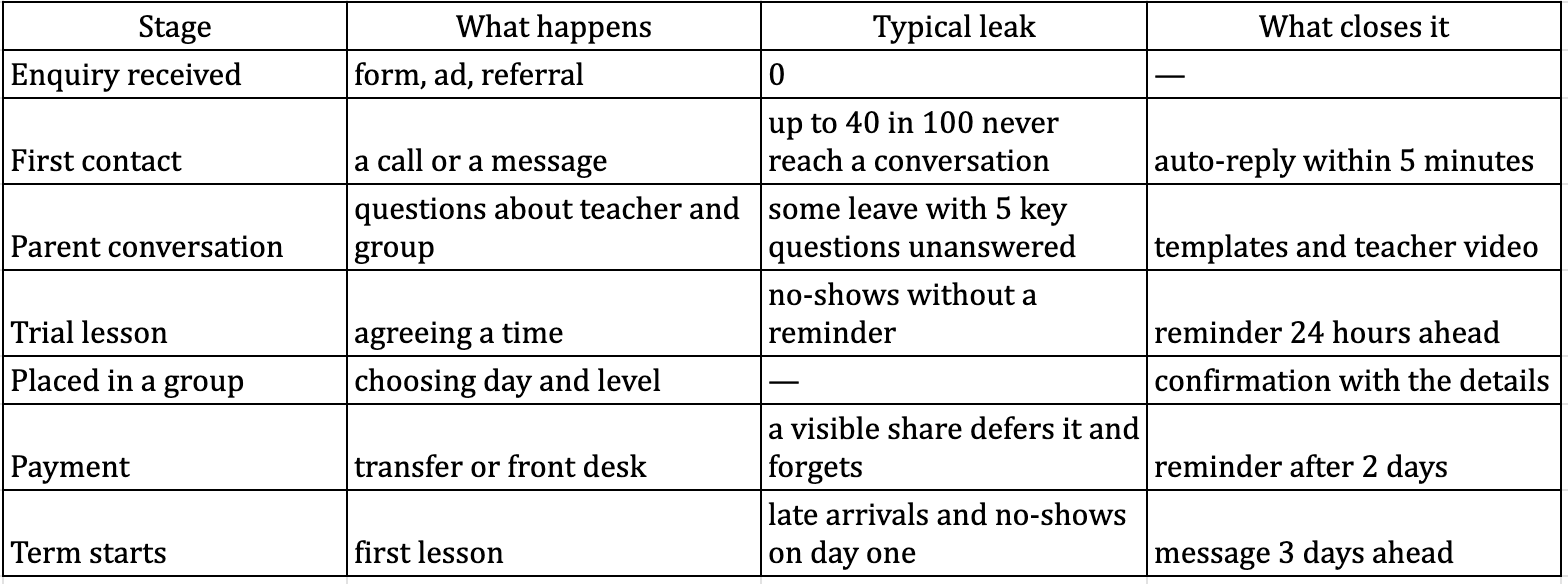
The gap between enquiry and first contact is the biggest leak
A parent fills in the form in the evening, because during the day they are at work. The administrator calls in the morning, the parent is in a meeting. A second call at lunchtime, the parent is driving. There is usually no third call.
In that same window the parent has written to two other schools and enrolled with whichever answered by message, the kind you can reply to in one line between other things.
A simple measurement. Take last season’s enquiries and count how many turned into a conversation within the first 2 hours. For most schools the figure comes out below 40%, and that number is what determines how full the groups are.
The decision rests on five questions, and none of them is price
Who teaches. How many children in the group. What happens if my child misses a lesson. Can we come to a trial class. What if the level turns out to be wrong.
All five get asked in writing and need a detailed answer. A phone call handles them worse, because what is heard gets forgotten while what is written stays and can be shown to the other parent.
The sign-up-to-payment gap closes with one message
One working term. The sign-up-to-payment gap is the interval between the parent agreeing and the money arriving. In peak season it stretches, because the parent puts the transfer off until the evening and forgets.
There are two reasons for the drop-off — they deferred and forgot, or they discussed it at home and changed their mind. A reminder after 2 days addresses both, yet almost nobody sends one, because the administrator is buried in new enquiries. This is where automation pays for itself fastest.
The setup that closes those gaps
The first message goes out within 5 minutes and asks one question
The enquiry arrives from the site, from an ad or through a referral. A deal is created in the card and a message goes to the parent’s messenger.
The text does not sell. It confirms the enquiry, gives the administrator’s name and asks one question — the child’s age and the goal of the course. Something like “Hello, this is Anna from School X, we have your enquiry about English. Could you tell me your child’s age and whether school curriculum or conversational practice matters more?”
One question instead of a questionnaire is the point. Parents have no time in enrolment season, and they answer whatever takes 5 seconds.
A 20-second video from the teacher speeds up the decision
From there the administrator runs the conversation from the card. Sends the group timetable as a file, a photo of the classroom, a short video message from the teacher.
In education the parent is buying a specific person, not a syllabus. Having seen a face and heard a voice, they decide noticeably faster than after reading a description of the methodology.
The trial lesson is offered in the same conversation with a specific date and time. An offer of two slots to choose from works better than an open question about what suits them.
Four automations take half the correspondence off the administrator
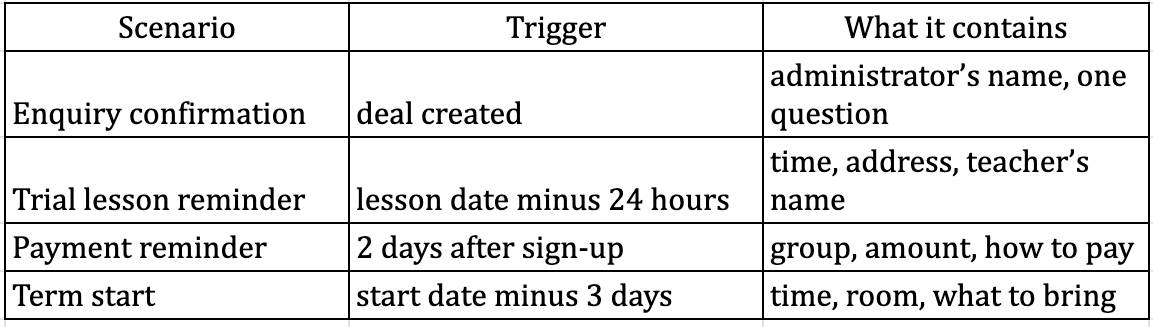
Here is what separates a working message from a useless one. “Enrolment is now open” achieves nothing. “The group for 9–10 year olds on Tuesdays and Thursdays at 5pm has 3 places left, starting 8 September” gets the parent to pay.
Each of the four messages is tied to an event in the CRM and pulls data from the card — the child’s name, the group, the date.
Last year’s base only works if the history was kept
Parents whose children studied last year and did not renew are the warmest audience available.
There is one condition. The message has to rest on history. “Your Tim studied with Olga in group A2, this year she is taking A2+, starting 8 September.” A message like that is only possible when the conversation and the data sit in the card rather than in the head of an administrator who has since left.
Expert note
A telling detail from training centres. Schools that actually measure enquiry-to-payment conversion almost always find the collapse falls in the last week of the season rather than the first. The cause is not demand but administrator overload. By the end of the month they handle three times the enquiries they did at the start, and answer quality drops. The right response is not to hire a second administrator for three weeks, it is to move everything repetitive into automations in advance, a month before the rush. Confirmations, reminders and start-of-term messages account for roughly half the correspondence. The other half needs a person, and now the administrator has time for it.
The technical side
One number with the whole shift working on it
The school shows parents a single contact while two or three people answer it on rotation. E-chat places no cap on the number of users per number on any plan, so bringing in extra help for the season costs nothing more.
The internal rule is that one administrator owns the conversation with a parent until payment. Changing the person mid-conversation about someone’s child makes a poor impression.
Parents use different messengers and moving them is futile
You cannot make somebody install another app. The practical answer is to connect the two channels that cover your audience and run both through one system.
Every conversation lands in the same cards, so the administrator never switches apps and never loses context. Replies come back into the CRM whether the message was sent from the system or from the messenger itself.
Six fields in the card without which none of this works
Child’s name, age, level, chosen group, trial lesson date, payment status.
These fields feed the automated messages. If even one of them is filled in only sometimes, a parent receives a message with a hole in it. Check how consistently they are populated before switching the automations on, not after.
The special case of families with more than one child
A situation that breaks field substitution. Two children from one family in different groups create two deals against one phone number, and the parent gets a doubled stream of reminders. For cards like these it is worth assembling one message covering both groups instead of sending two.
What to do with the time you have left
A week to launch, broken down by day
Days 1 and 2 — connect the number and link it to the CRM. Register, activate the number, let it sync, run the integration by the instructions. The first 7 days on the service are free, so the launch happens before you pay anything.
Days 3 and 4 — the writing. Four automated messages, five reply templates for the questions parents ask most, a short video from every teacher.
Days 5 and 6 — run it on yourself and on colleagues, check field substitution, set up inbound routing.
Day 7 — export last year’s base and send the first wave to the families who did not renew.
[H3] Three metrics to watch before term starts
Share of enquiries answered within the first 2 hours. Aim above 90%, which auto-confirmation makes achievable.
Conversion from enquiry to trial lesson and from trial lesson to payment. Keeping these two separate is essential, because a dip in each is fixed differently.
Share of parents for whom the payment reminder is what got them to pay. It reads straight off the cards and usually turns out higher than expected.
The real asset at the end of the season is the conversation history, not the groups
When renewal time comes round, that history turns into personal messages instead of a mass mailing.
The difference in response between “we invite you to renew” and “Tim finished A2, Olga is taking the next level” is measured in multiples.
When the playbook will not work
Speed of reply is meaningless without free slots
The argument of this article is simple — reply within 5 minutes and you fill your groups. The counter-argument is that a fast reply moves the parent towards a trial lesson, and if there are no free slots for a fortnight you are simply delivering the bad news faster.
The limit follows from that. Before launching, calculate your trial-lesson capacity for the season. In practice, either widen the trial schedule or replace the trial lesson with a conversation with the teacher in the messenger, otherwise the automation runs straight into a physical ceiling.
A small intake does not repay setting up four automations
A school with two groups and twenty enquiries in the season will handle them by hand faster than it can configure and test automation.
The break-even sits somewhere around 80 enquiries a season, or two administrators on a shift. Below that, a connected number without automations is the sensible stopping point.
What we have not measured
The leakage figures in the funnel table are a model for plugging in your own numbers, not a market average. The spread between schools is wide enough that averaging them would be meaningless.
We also have no data on online-only schools without a physical address. Their funnel lacks the trial-visit stage, so the thresholds in this article do not transfer to them.
FAQ:
Question: Will four automated messages feel like too many to one parent
Answer: Across the full cycle from enquiry to first lesson the parent receives 4 messages, and every one of them answers a question they would have asked anyway. Problems start when you add promotions and discount reminders, and those are best kept out of the enrolment sequence
Question: What if a parent writes at night
Answer: The auto-confirmation goes out immediately at any hour, and the substantive reply from the administrator arrives in the morning. Knowing the enquiry was received matters more to a parent than getting a detailed answer at midnight
Question: Does this work for adult groups and corporate training
Answer: The logic holds, the wording and cycle length change. Adults decide faster, and the question about the teacher is replaced by a question about results within a defined timeframe. Corporate work adds a stage for internal approval on the client’s side
Question: What if the school has several locations
Answer: It makes sense to give each branch its own number and run them through one CRM. Parents write to their branch while management sees the whole intake and can compare how the administrators perform
Question: Can we still launch this mid-season
Answer: The technical part takes under a day, the content about a week. Even a mid-month launch catches the densest part of the intake, which falls in the final fortnight
Was this article helpful?
Share it with colleagues who might need it
Connect messengers to your CRM
Message clients first right from the client card and keep all conversations in your CRM. 7-day free trial, up to 40% off when connecting several numbers.
Read also

Online store response time. How Viber and Telegram inquiries come together in one CRM
How a travel agency answers clients in 3 messengers from 1 window — a peak season case study
July. A traveller is choosing between Antalya and Hurghada, sends a question on WhatsApp, clarifies details on Telegram an hour later, and meanwhile his mother asks about the same package on Viber. The agent keeps 3 apps open plus a phone, a tablet and a spreadsheet of enquiries. Below is the actual setup a 5-person agency used to pull all 3 messengers into 1 window inside its CRM through E-chat, stop confusing conversations and cut first response time from 40 minutes to 4. Every step is described so you can repeat it in 1 working day.