WhatsApp in Brazil. Working with the world’s most messenger-driven market
Brazil is one of the rare cases where a messenger replaced not just the telephone but a good part of the internet. Small businesses here frequently have no website at all, they have a number. For an exporter that means the question is not which channel to pick but whether you can keep up with the local pace of conversation, where a three-hour silence reads as a refusal. Below are the market figures, the arithmetic of time zones, and what Brazil’s data protection law asks of your correspondence.
Key takeaways:
- WhatsApp reaches 85% of the audience in a country of roughly 212.8 million people, and only India has more users in absolute terms
- The second-widest channel is RCS at around 70%, with Telegram holding about 35%
- The gap with European working hours runs to several hours, and without a shifted shift every round of correspondence stretches to a full day
- LGPD requires a recorded basis for contacting people and controlled storage of the conversation
- Voice notes are a cultural norm here, and a dry text reply to a voice message reads as coldness
- A messenger does not replace document signing and does not solve cold first contact
The Brazilian messenger market in figures
We compiled this table from Infobip’s report on messenger popularity by country and open population data.
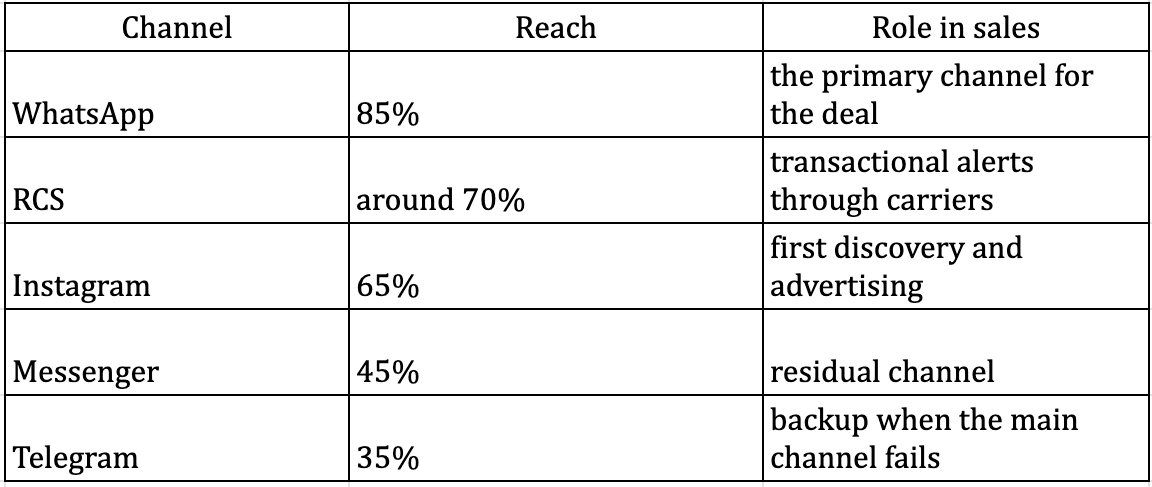
Source — infobip.com/blog/most-popular-messaging-apps-by-country.
The messenger works here as an interface to the outside world
People arrange work through it, call out tradespeople, order food and deal with government services. Engagement figures are among the highest of any communication channel anywhere.
The consequence for your sales process is direct. An enquiry has to become a message in the messenger, not a task to call somebody. Calls from international numbers frequently go unanswered here.
Instagram brings them in, WhatsApp closes them
Relying on one channel is a mistake. Advertising and first discovery often happen on Instagram at 65% reach, and the conversation then moves into the messenger.
So an enquiry from social media should turn into a conversation automatically. An intermediate step with a form or a callback request eats most of the traffic.
The whole deal fits inside the conversation
Brazil was among the countries where in-app payments were trialled. The buyer does not need to visit a website, register and enter a card.
For the seller that produces a specific requirement. Everything the customer needs in order to decide goes into the same conversation. Photos, specifications, delivery terms, the invoice. Any link that pulls them out of the chat reduces conversion.
The silence threshold and the time difference
One working term. The silence threshold is the interval after which a customer reads your silence as a refusal and goes to a competitor. This market has trained people to expect answers in minutes, so the threshold sits noticeably lower than in Europe.
A gap of several hours adds a full day to every round of correspondence
The country spans four time zones, with most economic activity in the UTC minus 3 zone.
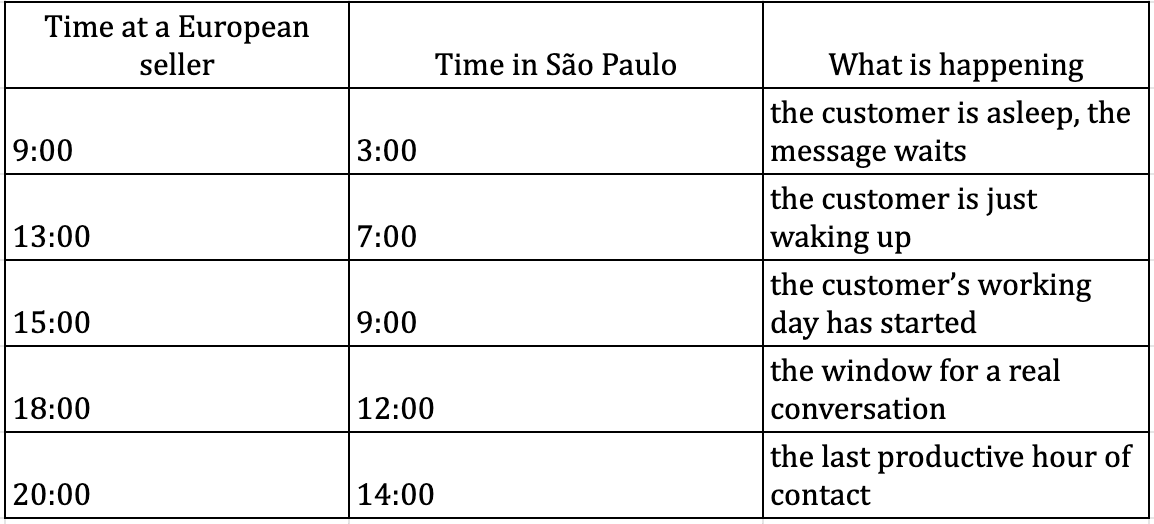
A company working to its own schedule gets two or three hours of overlap at the end of its day. The rest of the time messages accumulate on both sides, and every question from the customer is answered a day later.
A shifted shift plus an auto-reply closes the gap
The solution has two parts. One person works a shifted schedule covering the Brazilian morning. An out-of-hours auto-reply logs the enquiry in the CRM and states a specific time for the answer.
The second part is not optional. A customer who writes late in their evening will have written to your competitors by morning if they received nothing.
A reply in 15 minutes beats a detailed proposal
Exporters prepare a thorough commercial proposal and send it the next day, by which point the deal has gone.
The tactic that works is different. A short reply within 15 minutes, even when you have nothing substantive to say yet, plus a specific time when the details will arrive. A stated time that is then honoured builds more trust than raw speed on its own.
Language and LGPD requirements
Brazil speaks Portuguese, and it is not Spanish
Brazilian Portuguese differs noticeably from the European variety. Machine translation performs badly in commercial correspondence and produces stiff, formal wording.
Brazilian business communication is warmer and shorter than European. Using someone’s first name from the opening message is normal here, not overfamiliar. Have a minimal set of templates translated properly, once.
The data protection law makes four demands of your correspondence
Brazil’s LGPD follows logic close to the European regulation. It requires a basis for processing data, transparency, and a workable way for a person to opt out.
Consent to be contacted is obtained knowingly and recorded. The customer understands who is talking to them and why. Opt-outs are honoured promptly. Conversation history is stored under control, not on employees’ personal phones.
That last point is the one most often skipped and the most exposed. A Brazilian customer’s personal data sitting in the personal messenger of a departed salesperson is a breach you can neither explain nor undo.
How to record the basis for contact
The practical piece that usually gets postponed. Add a field to the customer card holding the source of consent and the date. The source can be a website form, a click-to-chat button or an inbound message from the customer themselves. Having the number in your database is not a basis, and this is the case where one missing CRM field costs more than the entire integration.
Running the customer through your CRM
The first message has four parts and no attachments
Being able to write first solves the situation this market produces constantly, where the enquiry contains a phone number and nothing else. Brazilians give out a number readily and everything else reluctantly.
Keep the structure short. Name, company, reason, one question. Proposals and attachments belong in the second message onwards.
A separate word on voice notes. People send them readily and listen to them readily, it is a cultural norm. A short voice note in reply to the customer’s own noticeably speeds up the relationship.
The full deal cycle runs without switching to email
The enquiry lands in the CRM, the salesperson opens the conversation from the card and sends specifications, photos, documents and the invoice from the same place. Replies come back into the same card.
Files, images, video, voice notes and video messages move in both directions. For companies with Latin American clients this matters more than usual, because technical correspondence with attachments is normally the most fragmented part of the process.
Four transactional notifications absorb most of the questions
Order confirmation, dispatch notice with tracking, a message when the shipment clears customs, delivery confirmation. Each tied to a status in the CRM.
Transactional messages perform better in this market than almost anywhere, because nearly everyone reads them and reads them immediately. The usual constraint applies — platforms treat messages to people who have never written to you differently.
Expert note
Exporters underestimate one thing — in Brazil the speed of your reply matters more than the quality of your offer. Companies arriving from markets with a different correspondence culture spend a day preparing the perfect proposal and lose to whoever answered in ten minutes with two lines. Checking this is cheap. Take your last 50 conversations, measure the time from the inbound message to your first reply, and set it against the share that reached a deal. The gap is usually visible without any statistics, and what it exposes is a problem with your shift schedule rather than with your salespeople.
Mistakes that cost you the market
Importing your domestic process unchanged
A company selling successfully in Europe through email and phone calls arrives in Brazil with the same process and gets silence.
What needs rebuilding is not the marketing but the handling of the enquiry. Everything else is secondary.
Salespeople on scattered personal numbers
When working a distant market the temptation to hand out personal accounts is especially strong. The consequences show up six months later.
You have the customer but no conversation, nobody knows who promised what, and as far as LGPD is concerned the company does not control its own customers’ personal data. A single company number connected to a CRM removes all three problems, and there is no cap on how many people work that number.
No backup channel
Messengers go down occasionally, and in Brazil that is more visible than elsewhere, because businesses have almost no alternative.
Sensible insurance is a second connected channel for critical notifications. Telegram at 35% reach fits the role, since part of your audience already has it.
When WhatsApp is not the answer
Legally significant documents stay outside the chat
The claim sounds convincing — the whole deal fits in the messenger. The counter-argument is that an export transaction needs a contract, an invoice and customs paperwork, and a file in a chat carries none of the force of a signed original.
The limit follows from that. A messenger works for agreeing the wording, for clarifications and for recording that something was sent, but it does not replace signing. In practice, keep the chat for speed and run document flow the way your two jurisdictions require, noting the fact of sending in the customer card.
Cold first contact runs into platform rules
Bulk messaging to unknown numbers hits the platform’s restrictions before it produces enquiries. For cold traffic in Brazil, Instagram advertising with a click-to-chat button is what works.
What we have not verified
The audience estimate of 140–148 million comes from open sources and varies between them. For planning, work from the lower bound.
We also have no data of our own on the share of deals closed through in-app payments. The capability rolled out in stages, so check its availability locally rather than from reviews.
FAQ:
Question: Do we need a Brazilian number to work with local customers
Answer: A local number raises reply rates at first contact, because international numbers here are more often associated with fraud. Once the conversation is running, where the number comes from stops mattering
Question: How does the approach differ from Mexico
Answer: Language and pace. Mexico speaks Spanish, Brazil Portuguese, and WhatsApp reach is higher in Brazil. Brazilian correspondence is warmer and accepts voice notes from the first messages, while Mexican tends towards a neutral business tone
Question: Can the same team handle Brazilian and European customers
Answer: Technically yes, all numbers connect to one CRM. Organisationally you will need a shifted shift, otherwise the time difference eats a day on every round of correspondence
Question: How do we record a customer’s consent to be contacted
Answer: With a field in the customer card holding the source and the date. The source can be a website form, a click-to-chat button or an inbound message from the customer
Question: What does a WhatsApp number cost
Answer: The plan is 15.99 dollars per number per month with no limit on inbound or outbound messages. Connecting three or more numbers and paying for 3, 6 or 12 months brings a discount of up to 40%
Was this article helpful?
Share it with colleagues who might need it
Connect messengers to your CRM
Message clients first right from the client card and keep all conversations in your CRM. 7-day free trial, up to 40% off when connecting several numbers.