Viber, Telegram and WhatsApp for business compared by country
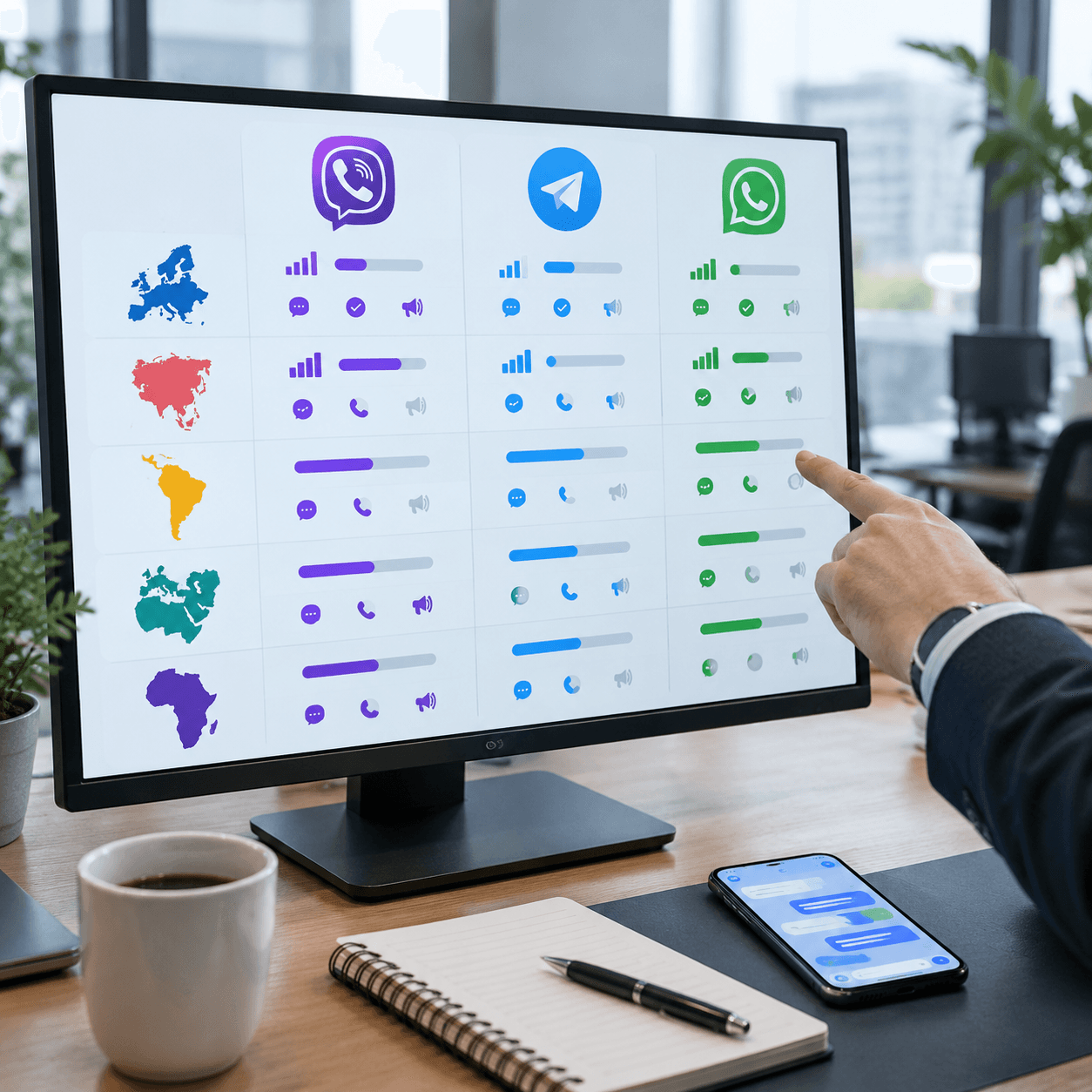
A map that paints each country in the color of one messenger tells you what people use. A sales team needs a different answer - where a customer will open a message from a company, reply, and get as far as paying. In Brazil and Mexico the two answers match. In the Philippines and Ukraine they diverge, because people there use two or three messengers, each for its own job.
We pulled figures for eighteen countries from public research, compared Viber, Telegram and WhatsApp on first-message limits, files and price, and laid out the process we use to pick a channel for a new market. Limits come from the E-chat help center, pricing from our website, and every market figure has its source named.
Key takeaways
- Studies of the same country can differ by dozens of points. Infobip puts Telegram in the Philippines at 20%, GWI at 56.3%, so it is too early to decide based on a single number.
- WhatsApp leads in Brazil, Mexico, India, Indonesia, Spain, Italy, the UK, the UAE, Turkey, Kazakhstan and Kyrgyzstan.
- Viber leads in Bulgaria, Greece, Serbia and Belarus, Telegram in Uzbekistan.
- In Ukraine and the Philippines, one channel is not enough.
- A new WhatsApp number can handle 5-10 first messages to new contacts per day, while a new Viber account risks a ban as early as the fifth. For an outbound campaign in a new country, connect the account a few weeks before launch and use it for inbound conversations first.
Why a popularity map doesn't answer the sales question
The studies measure different things. Infobip estimates which messengers are primary in a country, while GWI, via DataReportal, counts reach among internet users aged 16 and over. For Mexico, Infobip gives WhatsApp 75%, GWI for Q2 2025 gives 91.4%, and an Exploding Topics roundup based on the same GWI data gives 92.6%. A gap of more than 16 points comes from methodology, not from Mexicans.
Willingness to message a company is rarely measured. Mexico has such a measurement - Kantar, commissioned by Meta, found that 71% of adult online users in the country rank messaging first for speed and ease when they need to sort something out with a company. Where similar data doesn't exist, we look at two reach sources at once and at the business statistics published by the platforms themselves.
The Philippines and two different Telegrams
According to Infobip, Messenger leads in the Philippines with 95%, followed by Viber with 71%, WhatsApp with 40% and Telegram with 20%. GWI puts Telegram's reach in the same country at 56.3%. When two studies differ almost threefold, we don't take either at its word on Telegram and test the channel on our own customers.
E-chat doesn't connect Messenger, so among the channels available in a CRM, Viber comes out as the main one in the Philippines, with Telegram second, on a trial basis. Business figures back Viber too. According to a Viber press release, in 2024 business messages delivered in the Philippines grew by 53%, transactional messages, meaning delivery notices and purchase confirmations, by 89%, and conversations between brands and users by 95%. The number of small business accounts rose 194% year over year. The same release cites 92% of shoppers completing purchases on their phones.
Ukraine reshuffled the ranking in five years
In a 2021 survey published by Interfax-Ukraine, 73.6% of respondents used Viber, 42.7% Messenger and 31.6% Telegram. A 2026 survey published by Ukrainski Novyny gives Telegram 74%, Viber 59% and Messenger 54%. In the same survey, 74% get news through messengers, and the usage question doesn't separate reading channels from chatting with a store.
Hence our advice for Ukraine - connect both Viber and Telegram, and after a month pull a CRM report on where customers reply more often. We covered separately why Ukrainian customers would rather reply in Viber than pick up the phone.
Where there's nothing to debate - WhatsApp countries
In this group, WhatsApp reaches more than 80% of internet users according to at least one source, and the runner-up trails by at least 30 points. A second channel is needed here only as Telegram for a specific audience, and even then after the first few months of work.
Brazil and Mexico
For Brazil, Infobip gives WhatsApp 85% and Telegram 35%, and GWI puts WhatsApp's reach at 93.3%. We covered time zones, Portuguese and the local data protection law in detail in our article on Brazil, and the takeaway is short - one channel.
In Mexico, 27.6% of users name WhatsApp their favorite platform according to GWI, and AMVO estimates the country had 77.2 million digital shoppers in 2025. Second place in Infobip's data goes to RCS with 50%, Instagram and Messenger have 45% each, and Telegram 25%. For selling from a CRM, the choice is still WhatsApp.
India and Indonesia, where people pay in chat
WhatsApp's reach in India is 70% by Infobip and 82.9% by GWI. In Indonesia it is 65% and 91.3%, and Telegram there gets 30% from Infobip and 60.6% from GWI, so a second channel makes more sense in Indonesia than in India.
The WhatsApp Help Center lists four countries where people can pay registered businesses right inside WhatsApp - India, Brazil, Mexico and Indonesia. Since payment there is built into WhatsApp itself, buyers expect the invoice in the same chat, and the manager sends it or a payment link from the deal card. Just not in the first message - the E-chat help center lists links in first messages among the reasons WhatsApp bans accounts.
Spain, Italy and the UK
According to Infobip, WhatsApp is used by 85% in Spain and the UK and 75% in Italy. Telegram holds at 30-35%. WhatsApp is enough in these three countries. A separate number for each is set up for the managers' language and time zone, while the messenger is the same everywhere.
The UAE, Turkey, Kazakhstan and Kyrgyzstan
In the UAE, Infobip counts 90% for WhatsApp, 35% for Telegram and 20% for Viber. With a fifth of the audience, Viber is something we add in the UAE as a second channel only when customers themselves ask whether they can message there.
In Turkey, GWI gives WhatsApp 90.4% and Telegram 55.3%. In Kazakhstan, 83.4% of the population uses WhatsApp according to Kursiv, and CA Barometer names WhatsApp the top messenger in both Kazakhstan and Kyrgyzstan. We have a separate piece on managing deals in Kazakhstan.
Where Viber or Telegram comes first
Infobip names four countries where Viber leads - Belarus, Bulgaria, Greece and Serbia. Among the 30 large markets in the same review, Viber has a notable share only in the Philippines. Telegram leads in just one country on our list, Uzbekistan, but in six of the WhatsApp countries on our list it has 30-35% according to Infobip.
Bulgaria, Greece, Serbia, Belarus
In Bulgaria and Greece, Viber penetration is close to 90% according to third-party sources cited by Infobip. We covered sales in these two countries in separate articles. For Serbia and Belarus, our sources have no separate reach figures, only their place in the Infobip ranking, so we decide on them based on inbound inquiries.
Uzbekistan next to its WhatsApp neighbors
CA Barometer reports that 70% of people in Uzbekistan prefer Telegram, and Kursiv says 88% use it. Across the border, in Kazakhstan and Kyrgyzstan, WhatsApp comes first.
A company selling in Tashkent and Almaty connects Telegram and WhatsApp and assigns the same managers to both, and E-chat doesn't limit how many there are. For Telegram, the E-chat help center adds one detail. A first message sent by username leaves more room under the limits than one sent by phone number, so save the username from the lead form to the customer card.
Telegram as a second channel
According to Pavel Durov, as reported by TechCrunch in March 2025, Telegram has a billion monthly active users. WhatsApp has more than 3 billion, according to Meta. By country, GWI data shows notable Telegram shares in Indonesia at 60.6%, the Philippines at 56.3% and Turkey at 55.3%.
In markets where WhatsApp leads, we add Telegram as a second channel when customers ask to move there or come from your Telegram channel. In E-chat it costs $16.99 a month, so keeping it on trial is an easy call.
Limits, files and number price across the three messengers
In reach, the messengers compete for countries, but in a sales team's daily work it is the rules that set them apart. Telegram publishes no official limits, and some of the figures below are observations from our support team collected in the E-chat help center.
WhatsApp connects to E-chat through the web version, and its limits are the same as for a personal account. After activation, Viber must not be deleted from the phone it was activated on, but the phone itself can be switched off without affecting the service.
Message length and attachments
In Viber and Telegram, a single message holds up to 4096 characters. Viber sends files up to 200 MB, Telegram up to 128 MB. A 150 MB product video will go through in Viber but not in Telegram, where it has to be compressed or split. E-chat carries documents, images, video, voice and video messages in all three messengers, and all of them stay in the CRM history.
How many new conversations a number can handle
The limits apply to first messages to people who haven't chatted with this number before. WhatsApp has no restrictions in existing conversations, and none have been observed in Viber once the customer has replied at least once.
Viber is the strictest. A new number risks a ban as early as the fifth message to new contacts in a day. The help center recommends no more than 20 such messages a day and treating a previously banned account as new. Spam complaints also lead to bans.
In Telegram, stay within 20 new contacts a day, while older active accounts have room for up to 40. Telegram first restricts sending for a while, which in E-chat's observations lasts 4-24 hours, and bans permanently for repeated violations.
WhatsApp allows older active accounts 20-30 new conversations a day and new ones 5-10. Spread sending across the day, vary greetings, and keep links out of first messages. The help center also lists identical templates without personalization and frequent changes of devices and IP addresses among the reasons for bans.
Take a company entering Mexico that wants to reach out first to 400 trade show contacts within a month. A new WhatsApp number at 5-10 new conversations a day gives 110-220 first messages over 22 working days. The rest either moves to the second month, or WhatsApp is connected in advance and used for inbound conversations for the first few weeks until a chat history builds up.
What it costs to cover several countries
A WhatsApp number in E-chat costs $15.99 a month, Telegram $16.99, Viber $29.99. Every plan includes unlimited inbound and outbound messages and any number of managers, and you pay only for connected numbers.
For a sample calculation, take a company with customers in Ukraine, Uzbekistan, Kazakhstan and Mexico. Ukraine gets Viber and Telegram, Uzbekistan gets Telegram, and Kazakhstan and Mexico get WhatsApp each. Five connections cost $95.95 a month before discounts. When you pay for several at once, the monthly discount reaches 26% and the annual one up to 40%, the homepage promises extra discounts from three numbers, and special terms apply from 20.
[Expert insight] We have been working with customers from more than 30 countries since 2020, and the E-chat help center collects the ban reasons our support team sees. For Viber, 90% of them come down to one thing - the account starts conversations with new people too often. So when entering a new country, we advise planning for inbound messages and chats with people who have already replied first, and launching outreach to a new list later, at 5-20 contacts a day depending on the account's age.
How to choose a channel for a new country
We use the same process for every country. It relies on public reach figures, messenger limits, and what is already in your CRM.
Deciding on a single country
First, we compare two reach sources, Infobip and GWI. If both give one messenger more than 80% and the runner-up trails by 30 points or more, we go with one messenger. If the sources disagree or two messengers are close, as in Ukraine and the Philippines, we connect both and after a month check the CRM report to see which channel customers reply in more often.
Next, we calculate outbound volume. We take the number of new contacts the sales team plans to message first each month and divide it by the new account's limit and the number of working days. If the math doesn't work, we connect earlier or add a second account of the same messenger in the same country to split the load.
Last, we settle the language of the first message and the working hours. The first message is written in the country's language, arrives during the customer's business hours, and contains no links.
A separate number per country
A shared account for several countries saves money but puts all your eggs in one basket. A ban over a campaign in Mexico will also halt your Kazakhstan deals if both countries run on the same WhatsApp. A separate connection per country keeps limits apart and gives each market its own pipeline and report in the CRM.
The E-chat trial lasts 7 days. For that week, connect a messenger for the new country, link it to that country's pipeline in the CRM, and work only with inbound messages and customers who have already written to you. Start cold outreach after the trial, within the new account's limit.
FAQ
Question: Can we manage numbers from different countries in one CRM?
Answer: Yes. Each number connects to the CRM separately, and all conversations are saved in the customer card, whichever number they came through. E-chat works with more than 20 CRMs. Which messengers you can connect depends on the system. amoCRM, Kommo, Bitrix24, Creatio and NetHunt support all three, KeyCRM supports Viber only.
Question: What if our CRM isn't on the list of integrations?
Answer: Connect Viber via ApiX-Drive or Wepster, and for Telegram and WhatsApp build your own integration with the E-chat API, which is openly documented in the help center.
Question: Does the phone Viber was activated on need to stay on?
Answer: No, the phone can be switched off. You must not delete Viber from it or change the number with the messenger's built-in feature, and both restrictions are in the E-chat help center guidelines.
Question: Does E-chat limit the number of messages or contacts?
Answer: No. The service limits neither messages nor contacts, and the only restrictions come from the messengers' own rules.
Question: Will the history be kept if the number for a country has to be replaced?
Answer: If you change the number in E-chat with the CRM connected, the conversation stays in the customer card, and the manager picks up the dialogue where it left off.
Question: How do I contact support if a number in one of the countries gets restricted?
Answer: Message @echat_support_bot on Viber or Telegram. On weekdays from 9 am to 7 pm, support replies in 3 minutes on average.
Was this article helpful?
Share it with colleagues who might need it
Connect messengers to your CRM
Message clients first right from the client card and keep all conversations in your CRM. 7-day free trial, up to 40% off when connecting several numbers.