Changing your business number without losing the conversation history. A five-day plan
Nobody swaps a working number for fun. The employee it was registered to has left. The carrier changed. The company split departments across separate channels. A new market opened up in another country. In every case the fear is the same — that the negotiation history will disappear along with the number. Below is what actually gets lost, a day-by-day plan of work, and a list of situations where the switch is better postponed.
Key takeaways:
- Conversation history is tied to the customer card rather than to the number, so when you work through a CRM it stays put
- The technical side of the swap takes under an hour, the groundwork takes 3 to 5 days
- The notice goes out from the old number 3 days ahead and is repeated 1 day before
- The first message from the new number must contain no link, no invoice and no request
- Automations and integrations are remapped by hand, they do not migrate on their own
- The old number stays connected for another 30 days with a real person answering it
What is actually lost when you change a number
Worth sorting out before the work starts, because the fear is usually pointed in the wrong direction.
The conversation lives in the customer card, not in the app
When a number is connected to a CRM, messages land in the card and stay there. The number is transport, not storage. Replacing the transport does not erase what has already been delivered.
If the conversation was happening in an app on a salesperson’s personal phone, you do not need a number change to lose it. A resignation is quite enough.
Three things need attention, and none of them move automatically
First, the customers who are used to the old contact and keep it in their address book. Second, the automations and triggers in the CRM that reference the channel identifier. Third, every place the number is published, from the website and business cards to email signatures.
That is where the preparation time goes.
A number registered to a departed employee turns the job into an emergency
They have the SIM card, and they have access to the SMS confirmation as well. There is no time left for preparation.
The only prevention is to register work numbers to the company from day one and keep the SIM cards in one place.
The day-by-day replacement plan
We put this table together as a working schedule. One term for the final stage. The forwarding window is the period during which the old number remains connected and a human, not an autoresponder, answers what comes in on it.
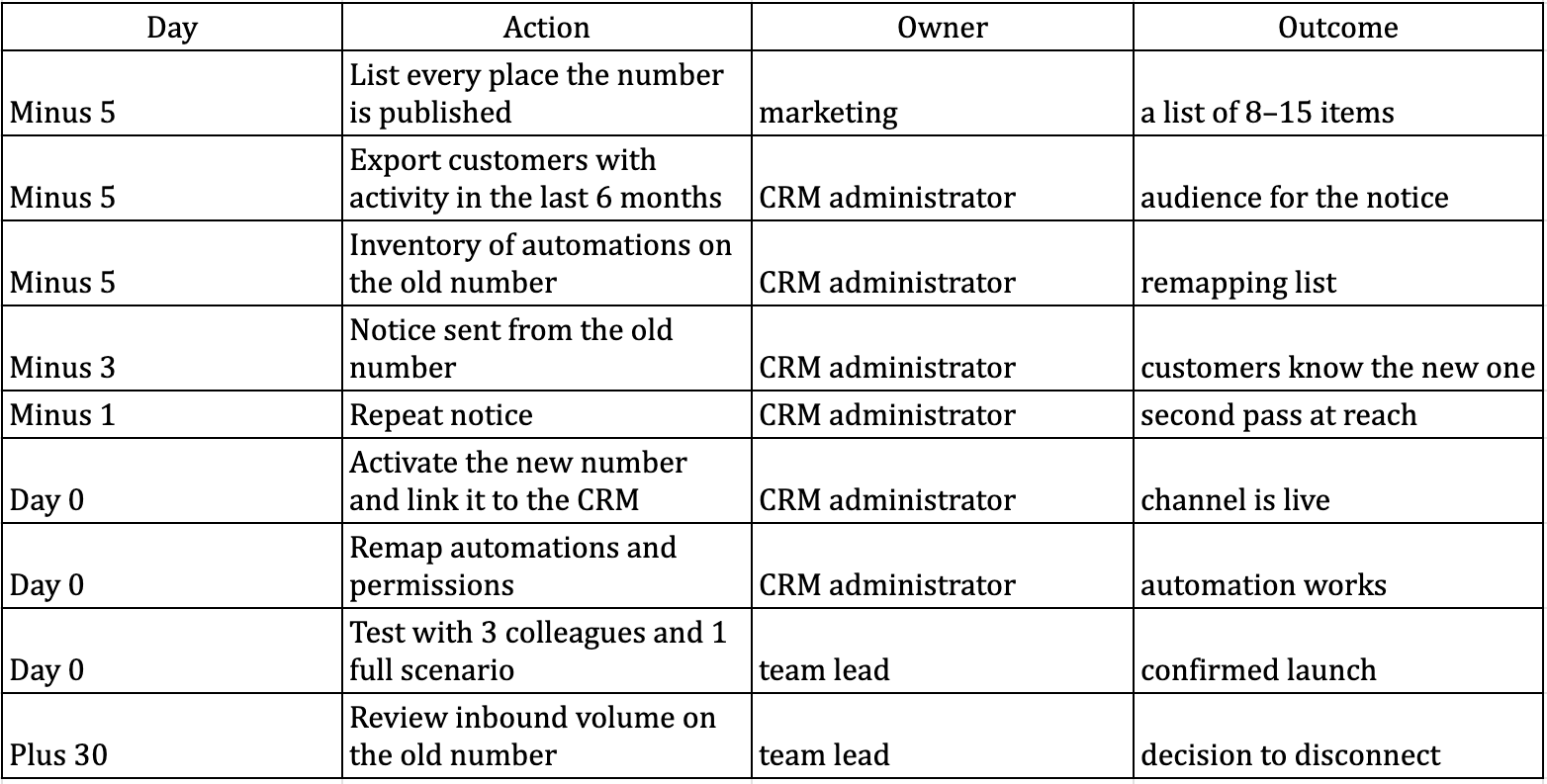
The publication list is almost always longer than expected
Website, directory and marketplace listings, ads, business cards, sales signatures, contracts, packaging, receipts, the voicemail greeting.
Exporting customers with activity over the last 6 months defines who gets the notice. Telling everyone else achieves little, they will come through the website anyway.
The notice goes out from the old number, into the existing thread
From the old one specifically. It has to arrive where the customer has already talked to you, and that is what makes it credible.
Keep the text short and skip the explanations. The company is changing its working number, from such-and-such date messages will come from the new one, the old one stays live for a month. Put the new number in the body of the message so the person can save it.
Repeat it 1 day before the switch. The first notice gets read and forgotten, the second one lands.
Budget half a working day for remapping
Activating the new number follows the same path as the first connection — add the number, confirm from the phone, sync, link it to the CRM.
Then come automations, templates, user permissions and inbound routing. Testing is mandatory and is done on real people, not on a test record. Message yourself and 3 colleagues, run 1 automation end to end, confirm that an inbound message lands in the right card.
Close the forwarding window on the numbers, not on the calendar
Some customers will keep writing to the old number for weeks, and somebody has to read those messages.
The right response is a human reply that mentions the new contact. An autoresponder reads as a refusal to talk. After 30 days look at the volume. Down to almost nothing — disconnect it. Still there — extend by another month, which costs less than the customers you would otherwise lose.
Expert note
The point almost everyone underestimates is that a number change reads to the customer as an alarm signal. People are used to fraudsters writing from new numbers in the name of familiar companies, and the reflex fires before the reasoning does. So the first message from a new number must carry no request, no link and no invoice. Only an introduction and one detail the two of you share — the last order number, the date of a meeting, the substance of the previous conversation. A single concrete detail removes suspicion more reliably than any reassurance. Companies that open on a new number with a sales pitch get a wave of blocks and then spend months wondering why deliverability dropped.
Recurring mistakes
Switching during peak season
Changing at the height of the season guarantees that some enquiries get lost in the noise. Pick a quiet stretch — the end of a month after the plan closes, a low-demand period, the gap between seasons.
Avoid Fridays specifically. If something goes sideways, you will be fixing it over the weekend.
Silence instead of a notice
It feels as though customers will simply notice the new number and carry on. In practice a message from an unknown number gets read less, and some people block it outright.
The cost of a notice is 1 message to your base. The cost of silence is losing contact with customers you have already paid to acquire.
Forgotten automations
The most common technical failure. The number changed but the trigger in the CRM still points at the old channel. Notifications quietly stop going out and you find out a week later from complaints.
Prevention is an inventory of automations prepared in advance and a mandatory run of every single one after the switch. Not a sample of them, every one.
Permissions that drop along with the channel
A small thing that surfaces on day two. Salespeople who had access to the old channel do not automatically get it on the new one. Half the team discovers this in the morning, by which point customers are already writing. Check permissions for everyone before the end of switch day, not selectively.
No single owner
A number change touches sales, support, marketing and the website at once. When everyone is responsible, nobody is.
Appoint one person with the authority to stop the process. Usually the CRM administrator, because most of the work happens there.
Prevention for next time
Three rules when connecting any new number
Register numbers to the company, not to an employee. Keep the SIM cards in the office. Set up a dedicated mailbox and recovery access.
These rules cost nothing at the start and save a week of firefighting later.
Numbers split by department limit the blast radius of any change
A company running sales, support and logistics on one number has to touch everything whenever anything changes.
Support gets a new manager — you touch one channel and sales keeps running. Discounts apply from 3 connected numbers, so this architecture costs less than it looks.
A standby number switches over in minutes
Common practice among companies with heavy inbound volume. A second number is connected, warmed up and held in reserve.
If something breaks on the main channel, the switch takes minutes instead of days. The cost of a standby number is comparable to 1 lost day of selling.
When to postpone the change
A new number does not fix a reputation problem
The argument sounds reasonable — the number picked up restrictions, so replace it and start clean. The counterargument is this. Restrictions come from the structure of your outbound, not from the number itself. A new number behaving the same way will collect them again, only faster.
The boundary is therefore straightforward. Replacement helps with technical causes — a carrier change, lost access, a departmental reshuffle. With platform-side problems you fix the sending pattern first. In practice, review the structure of your outbound over the last month, and if the share of messages to contacts who never wrote to you is high, change that rather than the number.
Peak season and live deals
If you have dozens of deals sitting in approval, moving the conversation to a new number injects noise exactly where you need certainty.
The sensible move is to wait for the current wave to close, or to keep the old number for live deals and launch the new one for inbound.
What we have not tested
The 3 days for the notice and 30 days for the forwarding window are working benchmarks for companies handling up to a few hundred conversations a month. For bases running into tens of thousands of contacts they need stretching, and we do not have precise figures at that scale.
We also do not cover the case where the number changes together with the messenger. That is a different task and needs its own breakdown per platform.
FAQ:
Question: Will the customer see the old conversation in their messenger after the change
Answer: In their own app the customer sees a new thread, because the thread is tied to the number. The full history stays on your side in the customer card, so your salesperson continues the conversation with all the context
Question: Can the old and new numbers stay connected at the same time
Answer: Yes, and that is the recommended setup for the transition. Both numbers run through the same CRM and write into the same cards, so no duplicates appear in the history
Question: How long does activating a new number take
Answer: The technical part is measured in minutes and needs access to the phone for confirmation. Most of the time goes on remapping automations and testing, usually half a working day
Question: What if the number changed without warning and we could not notify customers
Answer: Send a personal message from the new number that references a detail of your previous conversation, with no links and no offers. In parallel, update the number on the website and in directories, since some customers will check there
Question: Does the tariff change when a number is replaced
Answer: Pricing depends on the messenger and the number of connected numbers, not on the fact of a replacement. If the total count stays the same, your terms stay the same
Was this article helpful?
Share it with colleagues who might need it
Connect messengers to your CRM
Message clients first right from the client card and keep all conversations in your CRM. 7-day free trial, up to 40% off when connecting several numbers.